Laundry Types


In professional laundries, every wash cycle generates more than clean textiles. It also generates valuable operational data. From water and energy consumption to machine utilization, cycle times, and production volumes, this information can reveal opportunities to improve performance across the entire laundry operation.
Yet many laundry businesses still rely on manual reporting, experience, or occasional performance reviews to identify inefficiencies. While these approaches provide useful insights, they do not always offer the visibility needed to make timely, informed decisions.
This is where laundry analytics makes a difference. By transforming operational data into actionable information, laundry managers can identify inefficiencies, optimize resources, and make better decisions based on what is actually happening in their facilities.
But which data matters most, and how can laundries use it to improve everyday performance?
Laundry analytics refers to the collection, monitoring, and analysis of operational data to understand and improve how a professional laundry performs.
Connected equipment and laundry management software make it possible to gather information from different stages of the laundry process, including washing, drying, and other production activities.
Rather than looking at individual machines in isolation, analytics helps managers understand how equipment, resources, and workflows interact.
For example, a washing machine may be operating correctly but spending too much time idle between cycles. A dryer may be consuming more energy because textiles arrive with higher residual moisture. Or production may be concentrated at certain times, creating bottlenecks that affect the entire operation.
Laundry analytics helps identify these patterns and provides a clearer picture of where improvements can be made.
The objective is not simply to collect more data. It is to turn that information into better operational decisions.
Professional laundries operate in an environment where productivity, service quality, resource consumption, and operating costs must be carefully balanced.
A small inefficiency repeated across dozens of machines and hundreds of cycles can have a significant impact over time.
Without reliable operational data, identifying these inefficiencies can be difficult. Managers may know that production is taking longer than expected or that utility costs are increasing, but not necessarily understand why.
Data provides the visibility needed to move from assumptions to evidence-based decisions.
With access to relevant information, laundry managers can:
This visibility is particularly valuable in facilities operating multiple machines, processing different textile categories, or managing fluctuating production volumes.
By understanding what is happening across the operation, managers can make more informed decisions about equipment utilization, resource allocation, and production planning.
Not every piece of operational data is equally useful. The key is identifying the laundry KPIs that provide meaningful information about performance and help managers take action.
Although the most relevant indicators depend on the type and size of the laundry, several KPIs are particularly important.
This indicator measures how effectively available equipment capacity is being used.
Low utilization may reveal unnecessary idle time, inefficient scheduling, or an imbalance between machines and production demand.
Monitoring utilization helps managers identify opportunities to increase output without necessarily investing in additional equipment.
Tracking the kilograms of laundry processed per hour, shift, or day helps managers understand actual production capacity.
Comparing throughput across different periods can reveal changes in productivity and identify where adjustments may be needed.
Total water consumption provides useful information, but measuring liters per kilogram of textiles processed offers a more meaningful indicator of efficiency.
This KPI helps laundries compare performance across different production volumes and identify opportunities to optimize washing programs.
Monitoring energy consumption relative to production output helps managers evaluate how efficiently resources are being used.
Changes in this indicator may point to opportunities to improve washing or drying processes, review operating practices, or assess equipment performance.
Understanding how long machines spend washing, drying, waiting, or remaining unused helps identify inefficiencies within production workflows.
Even small reductions in idle time between cycles can contribute to higher daily output.
Unplanned downtime can disrupt production schedules and affect service reliability.
Tracking machine availability, recurring alarms, and maintenance-related interruptions helps managers understand their impact and prioritize corrective action.
Together, these laundry KPIs provide a foundation for measuring performance, identifying trends, and establishing realistic improvement targets.
However, the real value comes from analyzing them together rather than treating each indicator as an isolated number.
Collecting data is only the first step. The real challenge is understanding what it means and deciding what to do with it.
Imagine a laundry where production volumes remain stable, but energy consumption per kilogram begins to increase.
Looking only at the electricity bill may reveal higher costs, but it does not explain the cause.
Laundry analytics allows managers to investigate operational patterns. Are drying cycles taking longer? Are machines running with partial loads? Have wash programs changed? Is equipment spending more time in operation without a corresponding increase in output?
By connecting different indicators, managers can identify potential causes and determine which adjustments are worth testing.
The same approach applies to productivity.
If a facility consistently experiences delays during a particular shift, analyzing cycle times, equipment utilization, and production volumes can help reveal whether the issue is related to scheduling, machine availability, or workflow organization.
This means establishing a continuous improvement process: measure performance, identify opportunities, implement changes, and evaluate the results.
Over time, this approach helps laundries make decisions based on operational evidence rather than assumptions alone.
Improving laundry efficiency does not always require replacing equipment or making major changes to a facility.
In many cases, the first step is understanding how existing resources are being used.
Laundry analytics can support improvements across several areas of the operation.
Importantly, analytics does not automatically improve performance. Its impact depends on how effectively the information is interpreted and translated into operational changes.
This is why the combination of connected equipment, relevant KPIs, and informed management decisions is essential.
As professional laundries become increasingly connected, data is becoming an integral part of everyday operations.
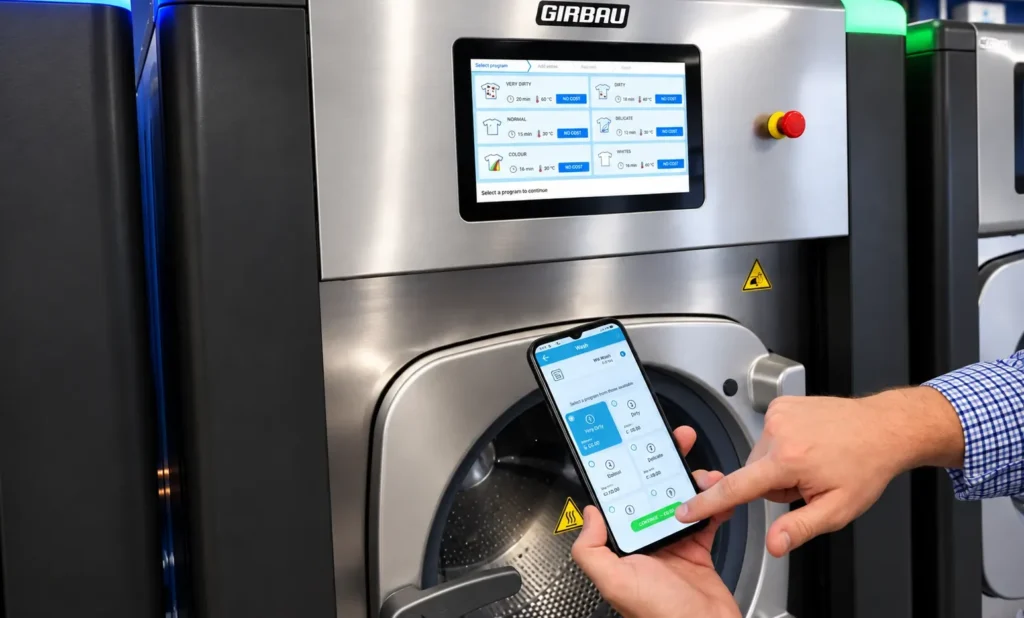
Modern laundry management software allows managers to access operational information more easily, monitor equipment performance, and gain visibility across their facilities.
At Girbau, we see connectivity as a way to help laundry businesses make better decisions and get more value from their equipment.
Through digital solutions such as Girbau Sapphire, laundries can access connected machine information and management tools that support greater operational visibility and more efficient workflows.
But connectivity is only the beginning.
The next step is making operational information increasingly useful: helping managers recognize performance trends, compare results, identify improvement opportunities, and make decisions with greater confidence.
As digital technologies evolve, laundry analytics will play an increasingly important role in connecting equipment performance with broader business objectives.
For laundry operators, this means moving toward a more proactive approach to management, where decisions are informed by data and continuous improvement becomes part of daily operations.
Ultimately, the smartest laundry is not necessarily the one that generates the most data, but the one that knows how to use it.
At Girbau, we help professional laundries combine advanced equipment, connected technology, and operational expertise to improve efficiency and build more productive, resilient operations.
Looking to make better use of your laundry’s operational data? Discover how Girbau’s connected laundry solutions can help you gain visibility, monitor performance, and turn everyday information into opportunities for improvement.